


The Great Migration Explained: Where the Herds Are Each Month
Follow the Great Migration through Tanzania month by month, from Ndutu calving and Grumeti to the Mara River and the herds' return south.
Plan around your priorities02
Understand real logistics03
Compare options clearly04
Travel with confidence
The Great Migration is not a single event and it does not belong to only one season. It is a continuous movement of wildebeest, zebra and gazelles through the wider Serengeti-Mara ecosystem as the animals follow fresh grazing and water.
At different times, the story may be newborn calves on the southern plains, long columns moving through the central Serengeti, gatherings near the Grumeti River, dramatic movement around the Mara River or a rapid return south after the short rains.
This annual pattern is reasonably predictable, but the dates are not. Rain may fall early, arrive late or concentrate in one part of the ecosystem. The herds respond to those local conditions rather than a human calendar. They also divide into many groups, sometimes spread over a vast area.
A responsible migration itinerary therefore matches the traveller's month with the most likely region, allows enough time in that region and includes excellent resident wildlife viewing even if the main herds move differently from the historical pattern.
The Great Migration at a Glance
| Period | Most likely region | Main migration story | Strong itinerary base |
|---|---|---|---|
| December-March | Ndutu and southern plains | Gathering, calving and predator activity | Ndutu, Kusini or southern Serengeti |
| April-May | Southern to central Serengeti | Rut and long northward columns | Seronera, Moru or seasonal camps |
| May-July | Western Corridor | Herds move toward Grumeti | Grumeti and western Serengeti |
| July-October | Northern Serengeti | Mara River movement and crossings | Kogatende, Lamai and northern camps |
| October-December | North through central to south | Return toward fresh short-grass plains | Lobo, central Serengeti and then Ndutu |
What Is the Great Migration?
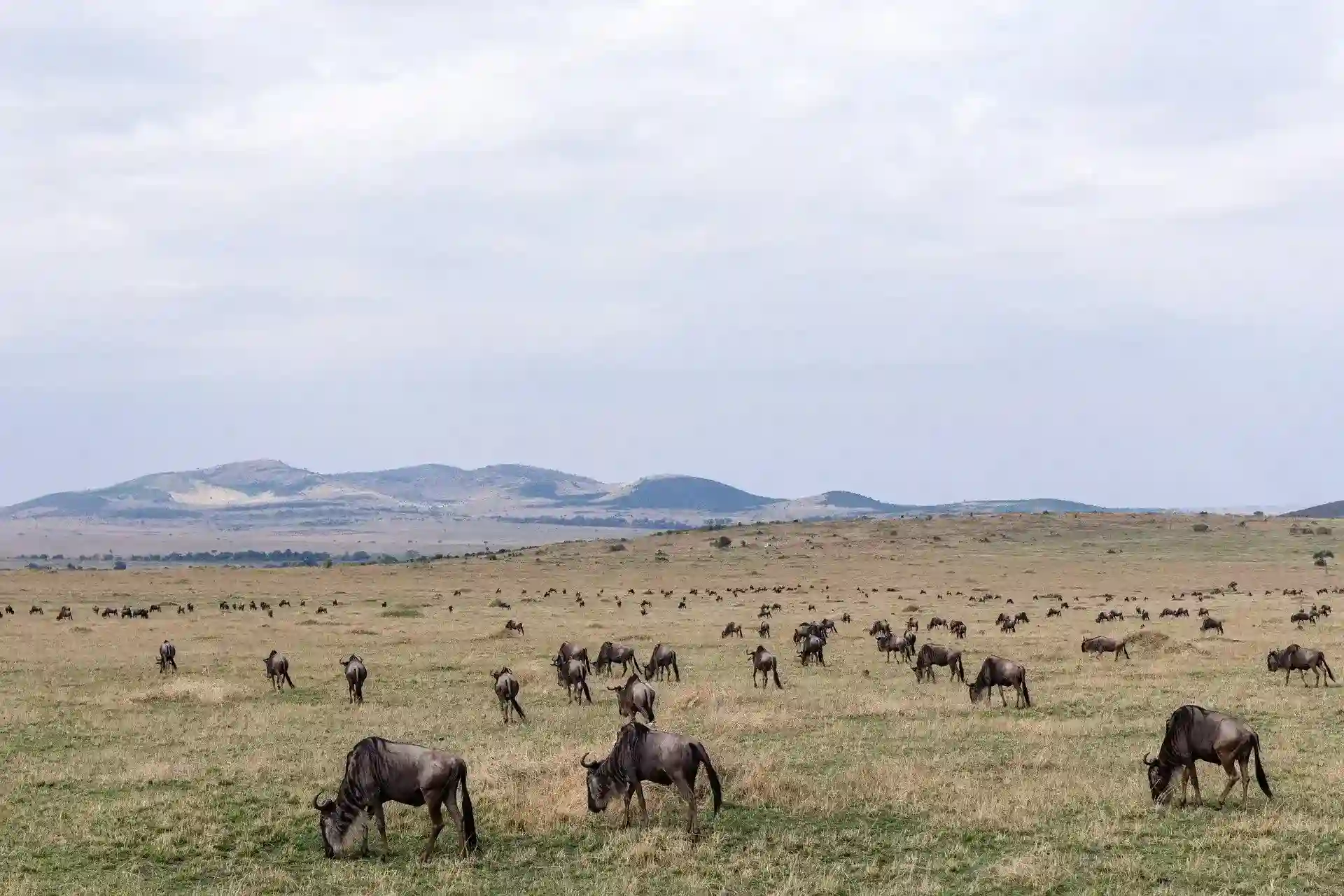
The Great Migration is the year-round movement of more than a million wildebeest accompanied by large numbers of zebra and gazelles. It takes place across a connected ecosystem that includes Serengeti National Park, the Ngorongoro Conservation Area, adjoining reserves and community lands in Tanzania, and the Maasai Mara in Kenya.
The word “migration” can create the impression of one organised herd travelling in a neat circle. In reality:
- Animals may be spread across dozens of kilometres
- Different groups can move in different directions
- Some herds remain behind while others advance
- River crossings may occur repeatedly in both directions
- Local storms can change the strongest grazing area within days
- Resident wildlife remains in every Serengeti region throughout the year
Wildebeest are the most visible participants, but the wider spectacle includes zebra, Thomson's gazelles, Grant's gazelles, eland, predators, scavengers and numerous birds. It is an ecological cycle rather than a race with a fixed start and finish.
What Drives the Herds?
Rainfall changes the quality and availability of grass and surface water. The southern short-grass plains become attractive after the rains because volcanic soils support mineral-rich new growth. This is the setting for the calving season.
As these plains dry, the animals seek better grazing and water farther west and north. The wetter northern part of the ecosystem acts as an important dry-season refuge. When short rains renew the south, many herds move back toward the calving grounds.
Several factors affect what travellers see:
- Where rain has recently fallen
- The condition of grass and water
- Fire and vegetation patterns
- The distribution of different herd groups
- River levels
- Road conditions and access
- The exact location of the selected camp
This is why a migration map should be read as a seasonal guide, not a timetable.
January: Herds Gather on the Southern Plains
By January, many wildebeest are usually spread across the short-grass plains of Ndutu, the southern Serengeti, Kusini and adjoining parts of the Ngorongoro Conservation Area. Green landscapes, scattered storms and large grazing herds create excellent wide-angle photography.
Some calves may already be present, especially later in the month, but January should not be sold as a guaranteed peak-birth period. The stronger reason to travel is the combination of massed herds, fresh scenery, young animals and active predators.
Best for
- Green-season landscapes
- Large herds on open plains
- Fewer visitors than the busiest crossing months
- Early calving activity
- Family safaris during school-holiday dates
Planning note
Choose accommodation in or close to the southern plains. A central Serengeti lodge may be several hours from the most productive Ndutu areas, and daily commuting reduces time with the herds.
February: Peak Calving Season
February is normally the heart of the wildebeest calving season. Many females give birth within a concentrated period, filling the plains with newborn calves. The open landscape provides remarkable opportunities to observe maternal behaviour, first steps, herd interactions and the constant pressure created by predators.
Lion, cheetah, spotted hyena and jackal may be active around the herds. The experience is not only about predation. Much of the day may involve quiet behaviour, nursing, movement between grazing areas and calves learning to follow their mothers.
Best for
- Newborn wildebeest
- Predator-prey behaviour
- Wildlife storytelling and photography
- Green plains and dramatic skies
- Travellers more interested in biology than river crossings
Planning note
Spend at least three nights in the Ndutu or southern Serengeti area when calving is the priority. Individual births and hunts cannot be scheduled, so more game-drive time improves opportunity without turning wildlife into a promise.
March: Late Calving and a Quieter South
Many herds remain on the southern plains through March, although their distribution can become more scattered. Calving continues, young animals are more mobile and the wider predator story remains strong.
The long rains may begin during March. Rain is often localised rather than continuous, and the clouds, green grass and soft light can be beautiful. Road conditions can become more challenging, and some camps begin seasonal closure later in the month.
Best for
- Calves that are becoming stronger and more active
- A quieter safari atmosphere
- Green-season photography
- Travellers comfortable with variable weather
Planning note
Use an experienced driver-guide and a suitable 4x4. Confirm seasonal-camp closing dates before booking, and keep the itinerary flexible enough to follow the strongest concentrations within the southern ecosystem.
April: The Herds Begin to Move North
April often brings the transition from relatively settled grazing to broader northward and westward movement. Herds may stretch from the southern plains toward Moru Kopjes and central Serengeti, while other groups remain farther south.
This is part of the long-rain period. Visitor numbers may be lower, landscapes are green and the movement can appear as long lines rather than dense stationary masses. The wildebeest rut may begin around this transition, adding mating behaviour and vocal activity.
Best for
- Long moving columns
- The rut and social behaviour
- Low visitor density
- Moody skies and lush scenery
Planning note
Avoid designing the trip around one fixed point. A base that provides access to the southern-central transition or a carefully chosen seasonal camp is more useful than assuming all herds have already reached the Western Corridor.
May: Central Serengeti Toward the Western Corridor
During May, many herds usually travel through central and western areas, often forming long columns as they search for new grass and water. Moru Kopjes, Seronera and routes toward the Western Corridor can all be relevant depending on rainfall.
May can be rewarding for experienced safari travellers because it combines migration movement with lower visitor numbers. It is still a rainy-season month, and some roads or remote tracks may be difficult.
Best for
- Herds visibly on the move
- Rutting behaviour
- Lower seasonal rates at some properties
- Combining migration with central Serengeti predators
Planning note
Ask for the most recent field information before the safari starts. A split stay between central Serengeti and the west may protect the itinerary better than committing every night to one edge of the ecosystem.
June: Western Corridor and the Grumeti Story
June is commonly associated with the Western Corridor and Grumeti River. As the landscape dries, large groups gather and move through western Serengeti. The river and surrounding woodland create a different setting from the open southern plains.
Grumeti crossings are often misunderstood. The river does not produce a daily, scheduled spectacle, and its crossings may be smaller or more dispersed than the iconic scenes at the Mara River. The Western Corridor remains valuable for moving herds, crocodiles, riverine habitat and resident wildlife even without a dramatic crossing.
Best for
- Western Serengeti landscapes
- Large herds approaching or passing the Grumeti
- Fewer vehicles than some northern crossing sites
- The transition into the dry season
Planning note
Allow several nights in the western region and treat a crossing as a possible bonus. Tanzania Inside Safari's 8-Day Grumeti Migration Safari is designed around the wider Western Corridor experience, not only a few minutes at the river.
July: The Long Push Toward Northern Serengeti
July is a transition month. Herds may still be spread through Grumeti and the Western Corridor while leading groups reach northern Serengeti. Early Mara River crossings can occur, but their timing depends heavily on rain and grazing.
This spread can make July exciting and difficult to predict. A traveller staying only in central Serengeti may be far from the strongest concentrations, while a northern base may be early if the herds have moved slowly.
Best for
- Dry-season wildlife viewing
- A chance of early northern movement
- Travellers who can use two Serengeti regions
- Combining central predators with migration tracking
Planning note
For early July, consider a west-and-north plan. Later in the month, northern Serengeti usually becomes the stronger migration focus. Recent local reports should guide the final game-drive decisions.
August: Northern Serengeti and the Mara River
August is one of the best-known migration months. Large numbers of wildebeest and zebra are often in northern Serengeti and across the wider Mara ecosystem. Herds may approach, cross and recross the Mara River as grazing conditions change on either side.
The river is only one part of the northern experience. Huge herds can spend long periods grazing away from the water, and predators remain active across the surrounding plains and valleys.
Best for
- Northern Serengeti game drives
- Large dry-season herd concentrations
- Potential Mara River crossings
- Travellers willing to wait patiently and stay several nights
Planning note
August is a busy, high-demand month. Secure northern accommodation well in advance, ideally for three or four nights. A river crossing cannot be guaranteed on any specific day.
September: Repeated Movement Across the North
September often finds significant herds in northern Serengeti and the Maasai Mara, with groups crossing the river in either direction. Dry conditions concentrate animals near permanent water, but local rain can quickly change their movement.
Some travellers incorrectly assume that all wildebeest are in Kenya during September. In many years, substantial groups remain or return to the Tanzanian side, and northern Serengeti continues to offer excellent migration and resident wildlife viewing.
Best for
- Northern Serengeti migration activity
- Potential back-and-forth river crossings
- Dry weather and open viewing conditions
- Combining migration with resident cats and elephants
Planning note
The strongest itinerary is based in the north rather than attempting daily drives from central Serengeti. Keep expectations broad: large herds and behaviour are the goal; a plunge into the river is a possibility.
October: The Northern Season Turns South
October is another transition. Some groups may still cross the Mara River, while others move through northern Serengeti, Lobo and the eastern side of the ecosystem on their journey south.
Thunderstorms may begin in parts of the north. The migration can become widely dispersed, making guide communication and flexible game drives especially valuable. Visitor numbers may ease later in the month.
Best for
- Late northern migration activity
- Possible return crossings
- Lobo and northeastern Serengeti scenery
- A balance of migration and resident wildlife
Planning note
Early October usually favours a northern base. Later dates may benefit from combining northern and central Serengeti rather than staying beside the river for the entire trip.
November: Following the Short Rains South
November is one of the least predictable migration months. The short rains encourage fresh grass, and herds may move rapidly through Lobo, eastern Serengeti and central areas toward the south. If rains are uneven, major groups can remain farther north or divide across several regions.
This uncertainty can reward travellers who value dramatic skies, fewer vehicles and the sense of tracking a natural event rather than arriving for a fixed show.
Best for
- Green-season transitions
- Lower visitor numbers
- Herds moving through central or eastern regions
- Flexible travellers and repeat safari guests
Planning note
Avoid building a November itinerary around one remote camp without alternatives. Central Serengeti is often a useful strategic base because of its resident wildlife and access to different directions.
December: The Cycle Returns to the Southern Plains
As short rains renew the southern grasslands, many herds usually move through central Serengeti toward Ndutu and the southern plains. Their exact arrival varies. In some years, strong groups reach the south early; in others, they remain dispersed into late December or January.
The first calves may appear, but the principal December story is the return to nutritious grazing and the rebuilding of large southern concentrations.
Best for
- Green landscapes and fresh grazing
- The return toward Ndutu
- Festive-season family travel
- Early calving and predator activity
Planning note
Christmas and New Year are busy travel dates even though herd locations remain weather-dependent. Reserve accommodation early and use a south-and-central combination if the arrival pattern is uncertain.
Month-by-Month Migration Planner
| Month | Likely focus | Main experience | Important limitation |
|---|---|---|---|
| January | Ndutu and southern plains | Gathering herds and early calves | Peak calving may not have started |
| February | Ndutu and the south | Calving and predator activity | Births and hunts are never scheduled |
| March | Southern plains | Late calves and green season | Rain and seasonal camp closures |
| April | South to central | Rut and moving columns | Herds can be widely dispersed |
| May | Central toward west | Northward movement | Roads and positions vary with rain |
| June | Western Corridor | Grumeti region and moving herds | River crossing is not guaranteed |
| July | West toward north | Transition to northern Serengeti | Herds may span several regions |
| August | Northern Serengeti | Mara River season | Crowds and uncertain crossing times |
| September | Northern Serengeti | Back-and-forth movement | Some herds may be in Kenya |
| October | North, Lobo and central | Late crossings and return south | Location shifts during the month |
| November | Central and eastern areas | Short-rain movement south | One of the least predictable months |
| December | Central to Ndutu | Return to southern grasslands | Arrival can be early or late |
River Crossings: What Travellers Should Understand
River crossings are extraordinary, but they are among the most overpromised safari experiences.
There is no crossing schedule
A herd may approach the river and retreat. It may wait for hours or days, cross outside normal game-drive hours or move to a different point. Another herd may cross in the opposite direction later the same day.
A longer northern stay improves opportunity
One night near the Mara River gives only a narrow window. Three or four nights allow guides to follow field information, explore different crossing areas and provide excellent game drives when the herds are away from the river.
Waiting is part of the experience
Guests may spend long periods observing gathering behaviour. The guide must balance patience with responsible positioning, park rules and other wildlife opportunities.
Ethical viewing matters
Vehicles should not block access to the river, pressure the herd or ignore ranger instructions. The aim is to observe natural behaviour without forcing it. A responsible guide may leave a congested site or choose a safer viewing position even when a closer vehicle appears possible.
Calving Season Is More Than Predation
The calving season is often marketed through dramatic hunts, but its deeper story is the synchronised arrival of new life on the southern plains.
Travellers may observe:
- Birth and immediate attempts to stand
- Calves identifying and following their mothers
- Nursing and maternal defence
- Herds spreading across mineral-rich grass
- Cheetah, lion, hyena and jackal behaviour
- Vultures and other scavengers completing the ecological cycle
- Storms, wildflowers and migratory birds
Photography should respect animal behaviour. A vehicle must not separate a mother and calf, surround a predator or create pressure around a birth.
How Many Nights Should You Spend With the Migration?
The right number depends on the season and the importance of a specific event.
| Priority | Recommended stay | Why it helps | Suitable plan |
|---|---|---|---|
| General migration viewing | 2-3 nights | Allows several game-drive sessions | Combine with central Serengeti |
| Calving season | 3 nights in the south | More time for births and predator behaviour | Ndutu-focused itinerary |
| Grumeti season | 3 nights in the west | Covers movement beyond the river | Western and central split |
| Mara crossing season | 3-4 nights in the north | Crossings are unpredictable | Northern stay plus central wildlife |
| Priority | Recommended stay | Why it helps | Suitable plan |
|---|---|---|---|
| Transitional months | Two Serengeti regions | Protects against dispersed herds | Central plus seasonal focus |
Travellers with limited time should focus on one well-matched region instead of rushing between distant parts of the Serengeti.
Road Safari or Fly-In Migration Safari?
Both approaches can work.
Road safari
A road safari keeps the same private vehicle and guide throughout the circuit. It is easier to combine Tarangire, Ngorongoro, Ndutu, central Serengeti and seasonal regions in a continuous journey. The trade-off is longer driving time, particularly to northern Serengeti.
Fly-in safari
A scheduled light-aircraft flight can save time when the priority is the distant northern Serengeti. It can also allow more nights near the Mara River. Baggage limits, flight schedules and camp-vehicle arrangements must be checked.
A combined plan
Many strong itineraries fly into northern Serengeti, spend several nights near the migration, then drive or fly onward depending on the season and the rest of the route.
Tanzania Inside Safari can tailor the balance between time, comfort, budget and the seasonal migration region.
Choosing the Right Camp Location
A camp described as “in the Serengeti” may still be many hours from the migration focus. Serengeti is vast, and seasonal geography matters.
Before booking, ask:
- Which airstrip and wildlife area serve the camp?
- How long is the drive to the likely herds?
- Is the camp permanent, seasonal or mobile?
- When does a mobile camp change location?
- What happens if the herds are early or late?
- Does the itinerary include enough nights to adapt?
- Is a private vehicle included or shared?
Mobile and seasonal camps improve positioning but still relocate according to planned dates, not the precise daily location of every herd. No camp can promise that wildebeest will pass directly in front of the tent.
The Great Migration With Children
The migration can be excellent for families when the itinerary respects children's ages and attention spans.
Calving-season safaris offer varied behaviour and open landscapes, while northern safaris may involve long waits at the river. Families should consider:
- Shorter game-drive blocks
- A private vehicle
- A camp with family rooms and suitable age policies
- Pool or rest time between drives
- Honest preparation for predation and animal deaths
- Snacks, water, sun protection and binoculars
Our 8-Day Luxury Family Mara Crossing Safari uses a fly-in northern stay to reduce road time and can be adjusted around the family.
Photography Planning
Each stage offers a different visual story.
- Southern plains: wide herds, calves, predators and dramatic skies
- Central movement: columns, dust and animals crossing open country
- Western Corridor: riverine woodland, crocodiles and compressed herds
- Northern Serengeti: riverbanks, dry-season light and large gatherings
- Return south: storms, green shoots and fast-moving groups
Bring two camera bodies when possible to reduce lens changes in dust, a wide or mid-range lens for environmental images and a longer lens for behaviour. Beanbags work well from a vehicle. Ask for a private photographic vehicle if positioning and patience are major priorities.
No photograph justifies disturbing wildlife or directing a guide to break park rules.
Migration Safari Booking Mistakes
Avoid these common errors:
- Booking central Serengeti for a short northern crossing trip
- Assuming “Serengeti” means every migration region is nearby
- Scheduling only one night at the seasonal focus
- Treating February or August as a guarantee of one specific event
- Driving from central Serengeti to the Mara River and back in one day
- Choosing a camp before confirming its seasonal position
- Ignoring resident wildlife when the herds move unexpectedly
- Selecting the shortest itinerary rather than the correct geography
- Expecting the guide to control animal movement
- Crowding a riverbank at the expense of responsible viewing
Which Migration Experience Is Right for You?
Choose calving season if you value newborns, predator ecology, green landscapes and behavioural photography.
Choose the Western Corridor if you prefer a quieter migration setting, moving herds and the Grumeti landscape without making the Mara River your only objective.
Choose northern Serengeti if a possible Mara River crossing is the main dream and you can allow enough nights, accept high-season pricing and remain patient.
Choose April, May, November or early December if you enjoy lower visitor density, dramatic weather and the unpredictability of following movement across a living ecosystem.
Our Great Migration Planning Approach
At Tanzania Inside Safari, we build migration safaris around seasonal geography rather than using one itinerary throughout the year.
Our planning includes:
- Matching travel dates to the most likely herd region
- Recommending enough nights in that area
- Combining migration zones with dependable resident wildlife
- Using recent field information during the safari
- Explaining the difference between likelihood and guarantee
- Choosing camps for location as well as comfort
- Considering road, flight and combined access
- Providing a private 4x4 with a professional local guide
- Adjusting daily game drives as conditions change
- Protecting wildlife welfare and following park rules
For July to early October, explore our 8-Day Mara River Crossing Migration Safari . For May to July, consider the 8-Day Grumeti Migration Safari . For the southern season, review the 10-Day Calving Season Safari .
Plan Your Great Migration Safari
Tell us your travel month, group size, preferred comfort level, photography interests and whether calving, moving herds or river crossings matter most. We will recommend the strongest region and itinerary structure for that period.
Explore more Tanzania safari experiences or use our trip-planning form for a personalised proposal.
Plan your Great Migration safari with Tanzania Inside Safari
For help matching your dates with the most likely migration region, contact our local Tanzania team .
Planning note: park conditions, flight schedules, lodge operations, road access and wildlife movement can change. Confirm the final details that apply to your travel dates before booking.