


Driving Safari vs Fly-In Safari in Tanzania: Time, Cost and Experience
Compare driving and fly-in safaris in Tanzania by travel time, cost, luggage, comfort, wildlife viewing and itinerary flexibility.
Plan around your priorities02
Understand real logistics03
Compare options clearly04
Travel with confidence
Should you explore Tanzania by private safari vehicle or fly between parks and camps? Both styles can produce an exceptional journey, but they create very different experiences.
A driving safari gives you one guide, one vehicle and a continuous journey through changing landscapes. A fly-in safari saves time on long transfers and brings remote wildlife areas within easy reach. Many of the strongest itineraries combine both: drive through parks that connect naturally, then fly out of the Serengeti or onward to Zanzibar.
The right choice depends on your available days, party size, budget, luggage, comfort preferences and the places you want to visit.
Driving and Fly-In Safaris at a Glance
| Feature | Driving safari | Fly-in safari |
|---|---|---|
| Main transport | Private 4x4 safari vehicle | Scheduled bush flights plus camp vehicles or road transfers |
| Time | More time travelling between destinations | Saves time on long sectors |
| Cost pattern | Vehicle and guide costs are shared across your party | Flight seats are usually priced per passenger |
| Guide continuity | Usually the same guide throughout | Guides may change between camps |
| Flexibility | Strong control over stops and daily rhythm | Flight times and camp schedules shape the day |
| Luggage | More generous, within vehicle capacity | Strict weight and bag-size limits |
| Scenery | Landscapes, villages and ecological transitions | Aerial views and rapid access to remote areas |
| Game drives | Usually private with your own guide | Often shared at camps unless a private vehicle is booked |
| Feature | Driving safari | Fly-in safari |
|---|---|---|
| Best suited to | Families, photographers, private groups and travellers who enjoy the journey | Short trips, remote camps, safari-and-beach combinations and travellers who prefer fewer road hours |
What Is a Driving Safari?
On a private driving safari, your guide collects you in Arusha, Moshi or another agreed starting point and travels with you through the itinerary in a customised 4x4 Land Cruiser.
The vehicle is not simply transport between hotels. It is your viewing platform, day room, photography space and connection between destinations. On Tanzania's northern circuit, a road itinerary can link Tarangire, Lake Manyara, the Ngorongoro Highlands and the Serengeti in a logical sequence.
You see more than the headline parks. The journey reveals farmland, Maasai country, escarpments, volcanic highlands, small towns and gradual changes in vegetation. Your guide can explain how landscapes, communities and wildlife areas connect.
What Is a Fly-In Safari?
A fly-in safari uses scheduled light-aircraft services or, less commonly, private charters to reach airstrips near parks and camps. These are often small aircraft operating through a network of bush airstrips.
After landing, a guide or camp representative meets you at the airstrip. The transfer to camp may become an introductory game drive, depending on the location and arrival time.
Fly-in does not necessarily mean every part of the safari is private. Scheduled flights are shared, airstrip transfers may be shared, and many camps include game drives with other guests. If you want a dedicated vehicle and guide, it must be requested and confirmed separately.
The Third Option: A Fly-and-Drive Safari
For many travellers, the best answer is not choosing one method for the entire trip. It is using each where it works best.
A common northern Tanzania journey is to drive from Arusha through Tarangire and Ngorongoro into the Serengeti, then fly from the Serengeti back to Arusha or directly to Zanzibar. This preserves the gradual overland story while avoiding a long return drive.
Another option is to fly into the Northern Serengeti during the Mara River migration season, then travel by road through different parts of the Serengeti and continue towards Ngorongoro. The ideal direction depends on the season, camp locations, flight schedules and the rest of your holiday.
Travel Time: Where Flying Makes the Greatest Difference
Flying becomes most valuable when the road transfer would consume much of a day or when the destination is remote from the rest of the itinerary.
Arusha to the Serengeti
Driving to the Central Serengeti is a full travel day, although the journey can include scenery, conservation areas and wildlife viewing after entering the park. Reaching the Northern Serengeti by road takes considerably longer and is normally built into a multi-stop itinerary rather than treated as a simple transfer.
A bush flight can reach a Serengeti airstrip much faster, but the published flight duration is not the whole journey. Travellers must also account for the transfer to the departure airport, check-in, possible intermediate airstrip stops and the drive from the landing strip to camp.
Serengeti to Zanzibar
Flying directly from a Serengeti airstrip to Zanzibar, when the appropriate service is operating, can connect safari and beach portions efficiently. Travelling entirely by road would require returning to a major airport before flying to the island.
Southern and Western Tanzania
Parks and reserves such as Nyerere, Ruaha, Katavi, Mahale and Gombe are spread across large distances. Flights can make these regions practical within a limited holiday, although schedules may operate only on certain days or require connections.
Road travel still has value in selected southern itineraries, especially when several destinations connect sensibly. The decision should be based on the complete route, not on a general rule that flying is always better.
Cost: Which Option Is Better Value?
There is no single answer because driving and flying are priced differently.
On a private road safari, the vehicle and guide are major shared costs. A couple carries most of that cost, while a family or group of four to six can divide it among more travellers. This often improves the per-person value as the private party grows.
Scheduled bush-flight seats are generally priced per passenger. Adding travellers therefore increases the flight cost more directly. A fly-in plan may also include airstrip transfers, camp-operated game-drive packages and private-vehicle supplements.
However, a flight can remove a night that would otherwise be needed to break a long road journey. It may also allow a short holiday to include a distant wildlife area. The correct comparison is the total itinerary cost and experience, not the flight price alone.
When comparing quotations, check whether they include:
- All scheduled bush-flight sectors
- Transfers between hotels, airports and airstrips
- Park and concession fees
- Private or shared game drives at each camp
- A private-vehicle supplement, if requested
- Accommodation and meal basis
- Luggage storage for items not taken on the aircraft
- Taxes and compulsory fees
- The effect of a missed or changed connection
Luggage Rules on Bush Flights
Luggage is one of the most important practical differences.
Scheduled safari airlines commonly apply total allowances of approximately 15 to 20 kilograms per passenger, often including hand luggage, cameras and personal items. The exact allowance, dimensions and excess-baggage rules depend on the airline, route, aircraft and ticket type, so the confirmed booking conditions are authoritative.
Soft-sided bags are normally the most practical because they fit more easily into small aircraft compartments. Large rigid suitcases may be refused even when their weight is acceptable.
Before a fly-in safari:
- Confirm the allowance shown on each ticket
- Include camera equipment in your calculation
- Use a soft duffel unless the airline confirms otherwise
- Avoid assuming that excess luggage can simply be paid for at check-in
- Ask whether extra baggage must be reserved in advance
- Leave unneeded items securely in Arusha, Dar es Salaam or another agreed location
- Pack medication, documents and essentials where the operator advises
Travellers combining Kilimanjaro with a fly-in safari often have bulky mountain equipment. Tanzania Inside Safari can arrange storage for gear that is not needed in the bush, subject to the final routing.
Scheduled Bush Flights Are Not Conventional Airline Flights
Safari flights are designed to connect remote destinations. The experience may include several airstrip stops as passengers join or leave the aircraft.
Schedules and routings can change because of weather, passenger loads, airstrip conditions, operational requirements or safety decisions. A group may occasionally be divided between aircraft. Departure and arrival times should therefore be treated as carefully planned but not immune to change.
Avoid building an important international connection immediately after a bush flight without a sensible margin. Your itinerary should include enough protection for transfers and possible operational changes.
Wildlife Viewing: Do You See More by Road or Air?
A flight saves transfer time but is not a replacement for game drives. Wildlife viewing happens after you land and enter a safari vehicle.
Driving can produce unexpected sightings between planned destinations. A transfer through a conservation area or park may become part of the wildlife experience, especially with a knowledgeable guide and enough time.
Flying can give you more usable time in one remote area by removing a long road sector. If a four-day trip would otherwise lose most of a day returning to Arusha, flying out may protect an extra morning game drive.
The best method is the one that creates more meaningful wildlife time without making the itinerary exhausting.
Guide Continuity and Personal Connection
A private road safari normally keeps you with the same guide for the journey. This continuity is valuable. The guide learns which animals, behaviours, landscapes and photography styles interest you, then builds on previous sightings.
On a camp-based fly-in safari, each camp may provide its own guides and vehicles. This can be an advantage because those guides know their immediate area intimately. The trade-off is that you may need to explain your interests again at every property.
Ask whether activities are private or shared and whether the same camp guide can accompany you throughout your stay. These details affect the experience as much as the flight itself.
Privacy, Vehicles and Seating
Tanzania Inside Safari's road safaris are designed as private journeys. Your party travels with its own professional guide and safari vehicle. For comfort, groups of up to six normally use one vehicle, while groups of seven or more are normally divided across two vehicles.
At many fly-in camps, the standard arrangement is shared game drives. The camp decides the vehicle departure times, combines guests and balances different interests. A private camp vehicle may be available at additional cost and often needs to be reserved early.
Before booking, ask:
1
Are the airport and airstrip transfers private or shared?
2
Are game drives private or shared at every camp?
3
How many guests can be placed in one camp vehicle?
4
Is a private vehicle available, and what does it cost?
5
Will private use be guaranteed in writing?
Photography and Specialist Interests
Photographers often benefit from a private road vehicle because equipment can remain organised and the guide can position around light, background and animal behaviour when conditions allow.
A fly-in safari can still be excellent for photography, especially when it saves time and reaches a productive remote camp. The limitations are luggage weight and the possibility of shared game drives.
Photographers should discuss:
- Total camera and lens weight
- Safe storage during flights and transfers
- Whether extra baggage must be reserved
- Vehicle layout and access to both sides
- Private-vehicle availability
- Charging facilities at camp
- The possibility of early departures or full-day drives
Birders and other specialist travellers should also establish whether the camp's standard schedule allows patient, interest-led viewing.
Families and Multigenerational Groups
Flying can spare children and older relatives a long transfer, but small-aircraft travel introduces different considerations. Aircraft cabins may be compact and noisy, boarding may involve steps or uneven airstrip surfaces, and baggage rules are strict.
Driving provides more control over stops, snacks and the daily rhythm. It also avoids repeated boarding and luggage handling. The disadvantage is the number of hours spent on the road.
For families, a hybrid itinerary is often effective: drive the naturally connected parks, build in suitable breaks and fly the longest final sector. Share children's ages, mobility needs and any concerns about small aircraft before the route is confirmed.
Accessibility, Health and Comfort
Neither option is automatically more comfortable for every traveller.
Road safaris involve vibration, dust and extended sitting. Some routes include rough surfaces, and bathroom stops are not always available exactly when requested.
Bush aircraft can involve narrow doors, steps, limited cabin movement and unpaved airstrips. Travellers with reduced mobility, significant back problems, anxiety about small aircraft or other medical concerns should discuss the actual aircraft and transfer arrangements before booking.
Medication and essential medical items must remain within the relevant airline's safety and baggage rules. If a condition could affect flying, seek individual medical advice before confirming the itinerary.
Weather and Seasonal Planning
Road and air operations can both be influenced by weather.
Heavy rain may slow road journeys, make some tracks difficult and affect access to remote camps. Flights may be delayed, rerouted or cancelled when conditions are unsuitable. Seasonal camp closures and changing wildlife concentrations can also affect which airstrip or road route makes sense.
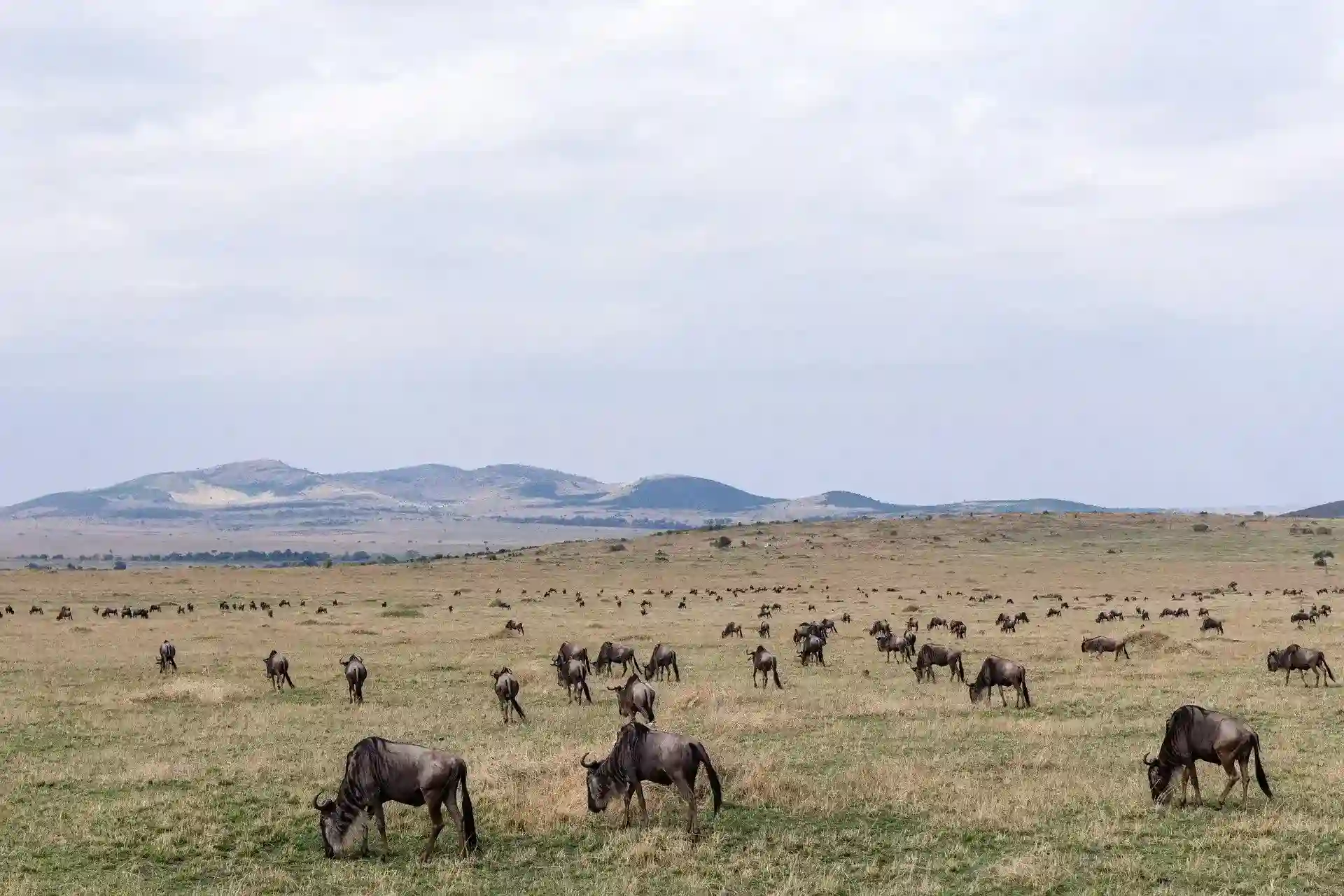
Migration safaris require especially careful planning. The Great Migration moves in response to rain and grazing, not a fixed calendar. Flying to Northern Serengeti in the river-crossing season can save time, while road itineraries may work better when the herds are moving through southern or central areas that connect naturally with Ngorongoro.
Is Flying More Sustainable Than Driving?
It is not responsible to assume that one transport method is automatically more sustainable.
The outcome depends on distance, aircraft and vehicle occupancy, route design, number of flight sectors, accommodation choices and how much unnecessary backtracking is avoided. A well-planned hybrid safari may be more efficient than either repeated short flights or an unnecessarily long road route.
Good planning means choosing a logical sequence, staying long enough to appreciate each area and avoiding a rushed checklist of distant parks.
Common Misunderstandings
"Fly-In" Means a Private Aircraft
Usually not. Most fly-in safaris use scheduled services shared with other passengers. A private charter is a different and substantially more expensive arrangement.
Flying Removes All Road Travel
No. You still need transfers to and from airports or airstrips, and wildlife viewing takes place in vehicles. Some camps are a significant drive from the nearest landing strip.
A Fly-In Safari Is Automatically Luxury
No. Flying describes transport, not the accommodation category. There are different camp styles, and the flight itself may be a practical time-saving choice rather than a luxury feature.
A Road Safari Is Mostly Dead Travel Time
Not necessarily. A well-designed route reveals landscapes, communities and wildlife transitions. Some transfers include game viewing, while others are genuinely long transit days. The itinerary should identify the difference honestly.
Fly-In Game Drives Are Always Private
No. Camp activities are frequently shared unless a private vehicle is specifically booked.
You Can Always Pay for Extra Luggage at the Airstrip
No. Small-aircraft capacity depends on weight, space and operating conditions. Extra baggage may require advance approval, an additional seat or a separate arrangement.
Which Safari Style Is Right for You?
Choose a driving safari if most of these statements sound like you:
- We want the same private guide throughout the journey.
- We enjoy seeing how landscapes and communities change between parks.
- We are a family or private group that can share vehicle costs.
- We have substantial camera equipment or more luggage.
- We want control over stops, pace and wildlife priorities.
- We have enough days to avoid rushing the road itinerary.
Choose a fly-in safari if most of these statements sound like you:
- Our holiday is short and time is more important than keeping costs low.
- We want to reach a remote camp or wildlife area.
- We prefer to avoid one or more long road transfers.
- We are comfortable with small aircraft and strict luggage limits.
- We accept that flight times and routings may change.
- We have confirmed whether camp activities are private or shared.
Choose a fly-and-drive safari if:
- You want a continuous overland journey without repeating the same road back.
- You are combining the Serengeti with Zanzibar.
- You want a private guide for the main circuit but a faster final transfer.
- Your itinerary includes one distant sector that does not connect efficiently by road.
Questions to Ask Before Booking
1
Which sectors are by road and which are by air?
2
How long is each transfer door to door, not just the flight time?
3
Are the flights scheduled services or private charters?
4
Can the flight make intermediate airstrip stops?
5
What luggage allowance applies to each ticket?
6
Are camera equipment and hand luggage included in the allowance?
7
Where can excess or unneeded luggage be stored?
8
Are camp game drives and transfers private or shared?
9
Will we keep the same guide throughout the road portion?
10
What happens if weather or operations change the flight?
11
Is there enough time before the international connection?
12
Would a hybrid route create better value and more wildlife time?
How Tanzania Inside Safari Designs the Journey
We do not add flights simply to make an itinerary appear luxurious, and we do not recommend long road sectors merely to reduce the headline price.
Our team studies the season, park sequence, party size, flight schedules, camp locations, luggage and the experience you want. We then recommend a private road safari, fly-in safari or combination that uses your time intelligently.
Road journeys use customised 4x4 Land Cruisers with pop-up roofs, charging facilities, refrigeration, binoculars and first-aid equipment. Our professional local guides stay focused on wildlife, safety, interpretation and the pace of your party.
For fly-in routes, we coordinate the flights, transfers and camp arrangements so that each handover is clear. We also identify where activities will be shared and where a private vehicle should be added.
Explore Safari Ideas
View our 4-day Serengeti fly-in safari
Explore a fly-in Serengeti safari from Zanzibar
Discover our family safari and Zanzibar journey
Plan the Right Safari Route
Tell us your dates, arrival airport, number of travellers, preferred parks, accommodation style, luggage needs and whether you are comfortable with small aircraft. We will compare the realistic options and design a route that balances wildlife time, comfort and value.
Start planning your Tanzania safari
The best safari is not the one with the most flights or the most kilometres. It is the one in which every transfer has a purpose and every day brings you closer to the Tanzania you came to experience.
Planning note: park conditions, flight schedules, lodge operations, road access and wildlife movement can change. Confirm the final details that apply to your travel dates before booking.