



Lemosho Route Kilimanjaro
The Lemosho Route is often considered the most beautiful of all the trekking trails up Mount Kilimanjaro. Approaching from the remote western side of the mountain, it crosses the entire Shira Plateau from west to east in a pleasant, relatively flat hike, passing through five distinct climate zones along the way. Crowds are low until the route joins the Machame route near Lava Tower, giving trekkers several days of relative solitude before the mountain's busier trails converge.
read more
close
It is one of the newer routes on the mountain and shares a portion of the same path as the Machame route, although it holds several advantages over that route that make it well worth considering, particularly for travelers who have some extra time.
Starting on the western flanks of Mount Kilimanjaro at the Londorossi Gate (elevation 7,742ft/2,360m), the Lemosho Route wanders its way up one of the more remote and untouched sections of the mountain, well away from the more heavily trafficked southern approaches.
The trail takes hikers through a beautiful rain forest where they might have the chance to spot wildlife along the way. Black and white colobus monkeys are routinely seen in the forests, as are blue monkeys, small lizards, elephant signs and a wide assortment of birds, including turacos and sunbirds. From there, the path wanders out onto the Shira Plateau — a vast, high-altitude volcanic caldera — crossing it from west to east on relatively flat and easy to walk terrain, with stunning views of Kibo's glaciated summit and, on clear days, Mount Meru in the distance.
Because Lemosho approaches from the west and gradually curves around to the south before summiting from Barafu Camp, trekkers gain altitude gradually over a longer distance than most other routes. This slow, steady ascent profile is the single biggest reason the route boasts such strong acclimatization and summit success rates, and why it is our most recommended route for first-time Kilimanjaro climbers.
LEMOSHO ROUTE MAP
The map below shows the full Lemosho Route path, from the Londorossi Gate on the western side of Kilimanjaro, across the Shira Plateau, around the southern circuit past Barranco and Karanga, up to Barafu Camp, and on to Uhuru Peak before descending via Mweka Gate.
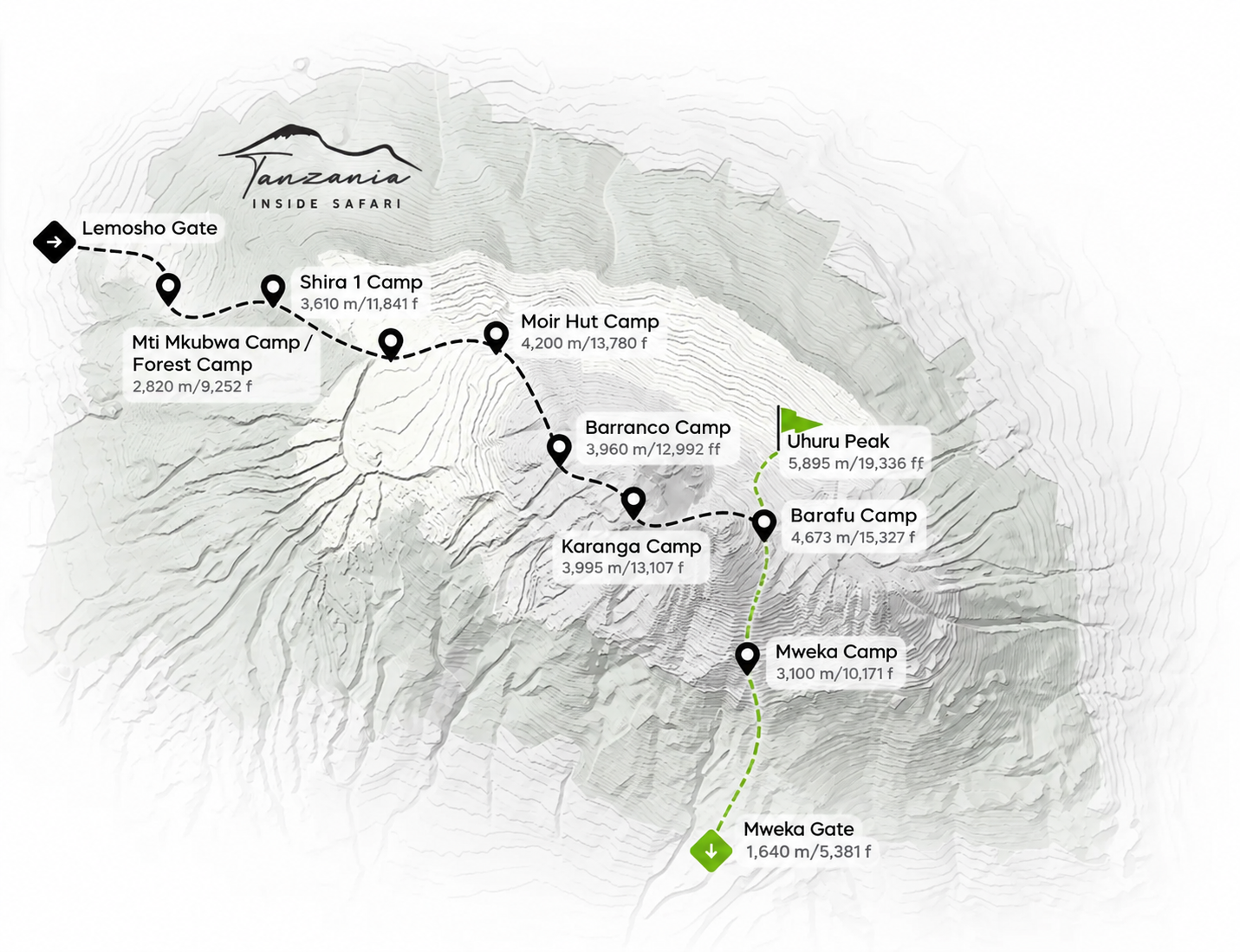
Tap or hover on the markers on the map to jump straight to that stage of the itinerary below.
WHY CLIMB KILIMANJARO VIA THE LEMOSHO ROUTE?
- Highest summit success rates on the mountain
- Most scenic route crossing 5 climate zones
- Low crowds for the first 3-4 days
- Gradual acclimatization profile walk high, sleep low
Lemosho's longer, more gradual approach gives your body more time to adapt to the thinning air, which is why it consistently produces some of the highest summit success rates of any route on Kilimanjaro. Combined with varied scenery rainforest, moorland, the alpine desert of the Shira Plateau, and the glacial arctic summit zone; it is widely regarded as the best all-round route for trekkers who have 8 days or more to spare.
OVERVIEW
- Duration 12 Day Tour, 11 nights, (8 Day Trek)
- Can be Tailor-made Yes
Tour Itinerary
This complete 12-day Kilimanjaro Expedition features a premier 8-day (7-night) climb along the scenic Lemosho Route, thoughtfully framed by an Arrival Day for seamless airport transfers, a dedicated Briefing Day for safety prep and gear checks, and a post-summit Decompression Day to unwind and celebrate before departing.
ITINERARY
Please note that in rainy/muddy conditions, sometimes the vehicles can’t make it to the true trailhead so there can be some extra hiking – After a picnic lunch, we will hike for about 4 hours to the forest camp.
In the forest, exotic moss and flowers delight the eye while bird calls entertain the ear. You may see Black and White Colobus monkeys as well as signs of the elephants that travel in this area. We will overnight at Forest Camp.
Hiking: 3-4 hours
Overnight Altitude ~9,498’
Hiking: 6-9 hours
Overnight Altitude 11,500’
Hiking: 5-6 hours
Overnight Altitude: ~13,650′
Hiking: 4-6 hours
Overnight Altitude: ~13,044′
Hiking: 3-5 hours
Overnight Altitude: ~13,106′
Hiking: 3-5 hours
Overnight Altitude: ~15,100’
Using headlamps (bring extra lithium batteries, which last much better in cold dark conditions!) you will ascend 6-7 hours to Stella Point and then another 1-2 hours to Uhuru Peak, the summit. After a summit celebration and photo, descend to Barafu camp for lunch and then to Mweka camp to sleep overnight.
Hiking: Very variable on both the up and the down; 12-17 hours typical
Summit 19,341’
Overnight Altitude: 10,448’
Hiking: 3-5 hours
Today is dedicated entirely to slowing down, unwinding, and processing the extraordinary journey you’ve just completed. After days of intense physical effort on the mountain, this is your time to relax, recover, and share personal summit stories with your fellow trekkers.
For those looking to maximize their remaining time in Tanzania, Moshi serves as the perfect starting point for a variety of unforgettable day trips. Whether you want to soothe your muscles or see more wildlife, you can customize your day with any of the following add-on excursions:
Culture & Scenic Hikes: Visit the stunning Materuni Waterfalls and enjoy a traditional coffee-making tour, or experience authentic local traditions with a Maasai village visit.
Total Relaxation: Soak your tired legs in the crystal-clear, warm waters of the Chemka Hot Springs.
Wildlife Day Safaris: Embark on a thrilling day trip to Arusha National Park, Tarangire National Park, the world-famous Ngorongoro Crater, or Mkomazi National Park.
(Please see our Extra Activities page for full details and to book these excursions!)
Note: Hotel check-out is at 11:00 AM. Late check-out options are available for an additional fee, if needed.
BEST TIME TO CLIMB THE LEMOSHO ROUTE
Kilimanjaro can technically be climbed year-round, but the driest and clearest conditions on the Lemosho Route fall in two main windows: late June to October (the long dry season) and late December to February/early March (a shorter, colder dry spell). These months offer the best visibility across the Shira Plateau and the highest chance of clear summit views. The rainy seasons, April-May and November, bring lower crowds and lush green scenery but muddier trails, especially through the rainforest zone.
WHAT TO PACK FOR THE LEMOSHO ROUTE
A full recommended packing list is provided during your pre-trek briefing in Moshi, and our guides will check your gear before you set off from the Londorossi Gate.
Download Kilimanjaro Packing List (PDF)How difficult is the lemosho Route?
The Lemosho route is considered one of the easiest routes on Kilimanjaro as it’s longer itinerary allows for better acclimatization. However, hikers will still need to ascend the Barranco Wall and climb steeply on summit night. No technical climbing is required but a good level of fitness is highly recommended. You can read more on training to climb Kilimanjaro and our Kilimanjaro training program page to help you prepare accordingly.
What is the distance of the Lemosho Route and how many days does it take?
The exact trekking distance for the Lemosho Route is 71km or 43 miles. The shortest number of days required for Lemosho Route is 7 days, but by the time you have added on arrival and departure days it is 10. However, as it is a much longer approach route it is actually best done over 8 or 9 days to increase your changes of success.
What is the Lemosho Route Summit Success Rate?
Due to its longer length profile, summit success rates on the Lemosho route are one of the highest on the mountain. Whilst there are no official statistics, the average success rate across all operators is 90% for the 8 day trek and a 85% success rate for the 7 day trek. However, We have a success rate of over 95% for the 8 day Lemosho route and a 92% success rate for the 7 day option. Read more about how many days it takes to climb Kilimanjaro to know why we recommend longer treks.
What is the Scenery like on the Lemosho Route?
The Lemosho Route is considered to be the most scenically beautiful of all the routes. The route takes trekkers from the west side of the mountain through lush rainforest before joining up with the Lemosho Route to cross the spectacular Shira Plateau. The route takes in the west and south of the mountain and the views are incredible, particularly from on the southern circuit.
How high is the Lemosho Route and what is the elevation profile?
The Lemosho Route starts at the Londorossi Gate (7,742ft/2,360m) and climbs to the summit at Uhuru Peak (19,341ft/5,895m). The extended itinerary allows for a "climb high, sleep low" acclimatization pattern, with several days spent gaining altitude gradually across the Shira Plateau and southern circuit before the final push to the summit.
Is the Lemosho Route suitable for beginners?
Yes. Thanks to its gradual ascent profile and longer duration, Lemosho is one of the most beginner-friendly routes on Kilimanjaro, provided trekkers have a reasonable baseline level of fitness and have done some pre-trip training. It is our most recommended route for first-time high-altitude trekkers.
What is the accommodation like on the Lemosho Route?
The Lemosho Route is a camping-only route. Trekkers sleep in mountain tents at designated campsites each night, with a dedicated crew of guides, cooks, and porters setting up camp, preparing meals, and carrying equipment ahead of the group.
INCLUDES & EXCLUDES
PRICES
$3,040



Kilimanjaro Frequently Asked Questions
Mount Kilimanjaro is one of the most iconic climbs in the world, drawing trekkers from all over the globe. However, preparing for this adventure involves many questions. We've compiled answers to the most common ones below. If you need more details, feel free to contact us for personalized assistance.
- Hike slowly to allow your body to adjust to the reduced oxygen levels.
- Drink 3-4 liters of water daily to stay hydrated.
- Participate in short acclimatization hikes to higher elevations during the climb.
- Consider climbing Mount Meru or other lower-altitude peaks as training.
- Opt for routes that last at least seven days to give your body more time to adjust.
What Travelers Say About Tanzania Inside and Safari
Jivyaant
Jun 2026 • Couples
The Perfect Tanzania Safari Experience
We had an amazing experience with this company from start to finish and would highly recommend them to anyone visiting Tanzania. Joseph was always quick to respond to our questions, very friendly, and completely transparent with pricing. The rates were fair and competitive, and there were no hidden surprises. All of the accommodations exceeded our expectations—they were comfortable, well-located, and added so much to the overall experience.
Read full review
Sightsee253101
Feb 2026 • Couples
Unbelievable 5 day of safari, experience for lifetime. 5 stars 🌟 lol
We had a 5 day safari to Tarangire NP, Serengeti NP and Ngorongoro NP. The lodges were we were staying were wonderful, the meals too. Our driver Hillary was so smart and he took us to the best spots to see all animals that are possible to see, even rhinos. It was a lifetime experience for us, 5 stars 🌟
Read full review
Nathalie
Aug 2025
A wonferful and unforgettable chimpanzees safari in Mahale Mountains
My partner and I had the great opportunity to go on a chimpanzee safari in the Mahale Mountains. We are delighted. It was an extraordinary experience! Everything was extremely well organized and went perfectly. Communication with Joseph was very easy: he always responded quickly to my many questions and did everything to meet our expectations. We had the opportunity to design an itinerary together that matched our wishes.
Read full review
Thoibi N. Rublaitus
Jul 2025 • Friends
Well coordinated, great guides, and support staff.
Tanzania Inside and Safari arranged our 8-day climb to Mt. Kilimanjaro on the Rongai Route. The guides were experienced, considerate and compassionate. The chef and waiter were great at make sure our meals were nutritious and wholesome every meal. The tent team and the porters were excellent too: always on time and perfectly set every day. On the summit day, Andrew, the guide, was the reason a team member who was unlikely to make it made it to Uhuru Peak, made it.
Read full review
stayhappyalways h
Sep 2025 • Couples
Best decision ever
It’s was an amazing experience from start to finish. Our guides where welcoming, very experienced and polite. We had a customized trip and Joseph helped us with that. Thank you for making our journey unforgettable.
Read full review
Johanna G
Aug 2026 • Friends
An Unforgettable Journey – Highly Recommended!
Our trip through Tanzania was absolutely amazing and very individually tailored to us. The agency organized everything for us during our stay: accommodations, transfers, domestic flights, activities and, of course, the guides. From the beginning, we felt that our wishes were truly taken into account. What we appreciated most was the individual way the activities were planned. Even in places with many tourists, the team always found a way to create special experiences for us.
Read full reviewLet's talk about your
Trip to Africa!
All our custom itineraries are inspired by our travel experts and positive feedback from past travelers. We're sharing them so you can get a taste of the experience. However, we're flexible and can tailor-make an itinerary just for you. Let us know your preferences (parks, accommodation, timing, etc.), and our safari experts will create a personalized proposal. USEFUL ARTICLES PLAN MY TRIP
Let's talk about your
Trip to Africa!




Unleash the wild beauty of Africa! Trek Mount Kilimanjaro, roam the Serengeti, and explore Ngorongoro Crater—your extraordinary safari awaits. Book Your Dream Adventure Today!
Close