



Umbwe route Kilimanjaro
The Umbwe Route is known for being the most direct and challenging path to Mount Kilimanjaro’s summit, offering a unique and rewarding trekking experience for adventurous climbers.
This route is less crowded, providing an immersive wilderness adventure and stunning views of the mountain's diverse landscapes. Its steep ascent tests both physical endurance and determination, making it a favorite for seasoned trekkers.
read more
close
Unlike other routes, the Umbwe Route starts with a rapid ascent through lush rainforest, quickly giving way to the moorlands and then the alpine desert. This steep and direct approach offers fewer opportunities for acclimatization, which is why it is recommended for those with prior high-altitude trekking experience.
As you climb, the scenery shifts dramatically, with breathtaking views of deep gorges, ridges, and eventually the iconic summit of Uhuru Peak. The rugged trail requires a high level of fitness and mental stamina, but the rewards are well worth it.
The route offers an incredible sense of solitude and connection with nature, as it is less traveled compared to other Kilimanjaro routes. This makes it an ideal choice for those seeking a more secluded and challenging trek.
Due to its steep nature, the Umbwe Route has a higher success rate for those who are well-prepared and acclimatized. Trekkers should be ready for rapidly changing weather conditions and ensure they are equipped with proper gear and guidance.
Overall, the Umbwe Route provides a raw and unfiltered Kilimanjaro climbing experience, with dramatic scenery and the sense of accomplishment that comes from conquering one of the toughest paths to the summit.
UMBWE ROUTE MAP
The map below shows the direct Umbwe Route from Umbwe Gate to Umbwe Cave Camp before joining the southern circuit at Barranco Camp. From there the trail continues through Karanga and Barafu Camp, climbs to Uhuru Peak and descends through Mweka Camp to Mweka Gate.
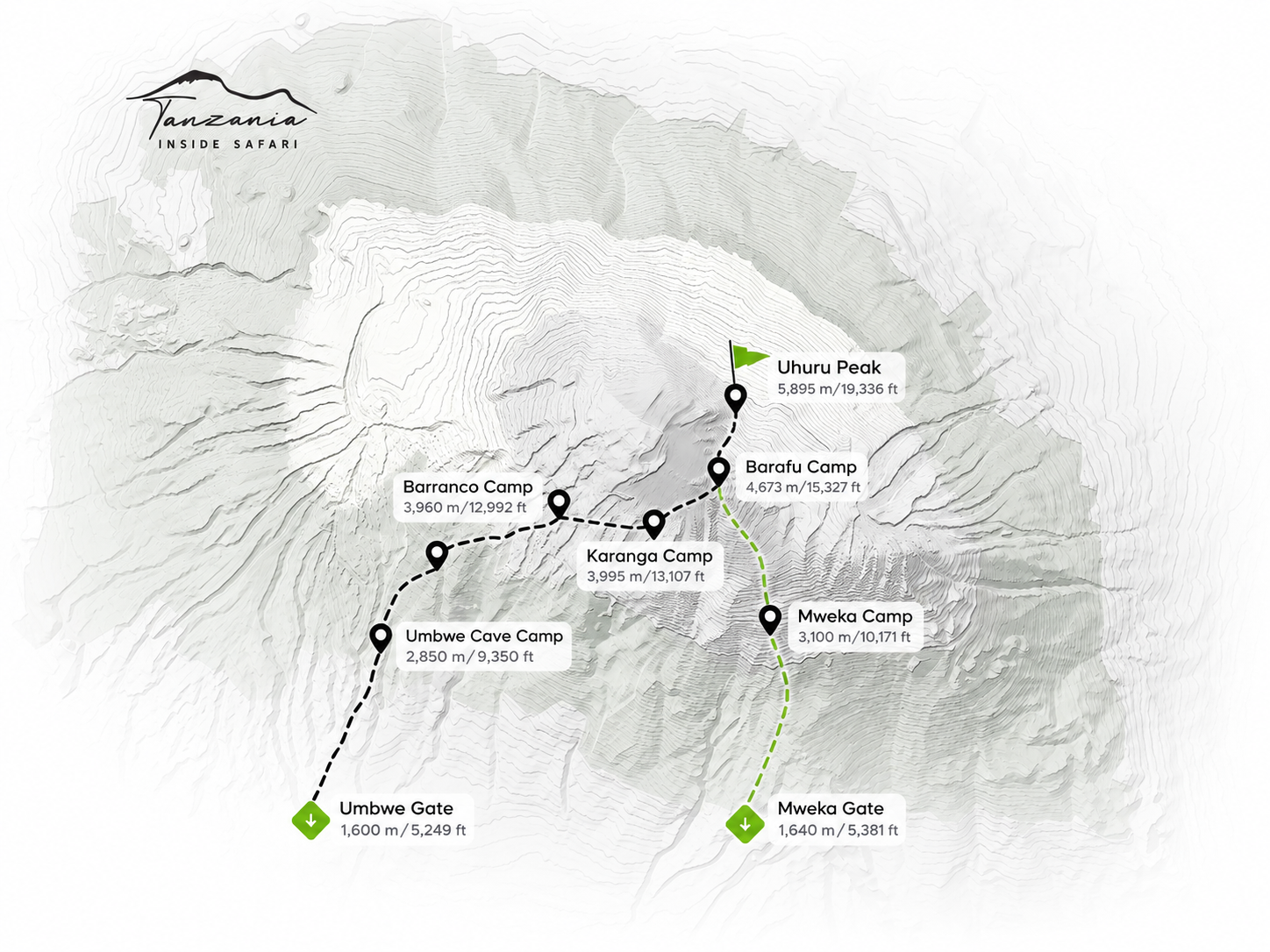
Follow the route map together with the detailed day-by-day itinerary below.
WHY CLIMB KILIMANJARO VIA THE UMBWE ROUTE?
- Most direct approach a steep and demanding ascent
- Low trail traffic a more secluded mountain experience
- Dramatic scenery rainforest, ridges, deep gorges and alpine terrain
- For experienced trekkers best suited to strong, well-prepared climbers
Umbwe is designed for trekkers seeking a steeper, more direct and less crowded Kilimanjaro climb. The route rises quickly through rainforest and dramatic ridges before joining the southern circuit at Barranco. Because acclimatization time is limited, it is best suited to experienced, physically prepared climbers.
OVERVIEW
- Duration 10 Day Tour, 7 nights, (6 Day Trek)
- Can be Tailor-made Yes
Tour Itinerary
This complete 10-day Kilimanjaro Expedition features a comprehensive 6-day (5-night) climb along the dramatic Umbwe Route, thoughtfully framed by an Arrival Day for seamless airport transfers, a dedicated Briefing Day for gear checks and safety preparation, and a post-summit Decompression Day to unwind and celebrate before departing.
ITINERARY
Hiking: 5-7 hours
Overnight Altitude: 2,899m / 9,514ft
Habitat: Heath
Hiking: 4-5 hours
Overnight Altitude: 3,975m / 13,044ft
Habitat: Heath/Moorland
Hiking: 4-5 hours
Overnight Altitude: 3,994m / 13,106ft
Habitat: Alpine desert
Once you arrive at the Barafu camp, it is time to organize your equipment and warm clothes for tomorrow’s journey to the peak. To prevent freezing, keep any water your plan on bringing in a thermos. Get to bed early, as the next day’s trek requires a full night’s sleep worth of energy. You are getting ready to take on Kilimanjaro’s most ultimate challenge!
Hiking: 4-5 Hours
Overnight Altitude: 4,672m / 15,331ft
Habitat: Alpine Desert
Hiking: 7-8 hours (ascent) / 4-6 hours (descent)
Overnight Altitude: 3,067m / 10,065ft Habitat: Arctic (Summit) / Rainforest (Descent)
Hiking: 3-4 Hours
Final Altitude: 1,639m / 5,380ft
Habitat: Rainforest
Today is dedicated entirely to slowing down, unwinding, and processing the extraordinary journey you’ve just completed. After days of intense physical effort on the mountain, this is your time to relax, recover, and share personal summit stories with your fellow trekkers.
For those looking to maximize their remaining time in Tanzania, Moshi serves as the perfect starting point for a variety of unforgettable day trips. Whether you want to soothe your muscles or see more wildlife, you can customize your day with any of the following add-on excursions:
Culture & Scenic Hikes: Visit the stunning Materuni Waterfalls and enjoy a traditional coffee-making tour, or experience authentic local traditions with a Maasai village visit.
Total Relaxation: Soak your tired legs in the crystal-clear, warm waters of the Chemka Hot Springs.
Wildlife Day Safaris: Embark on a thrilling day trip to Arusha National Park, Tarangire National Park, the world-famous Ngorongoro Crater, or Mkomazi National Park.
(Please see our Extra Activities page for full details and to book these excursions!)
Note: Hotel check-out is at 11:00 AM. Late check-out options are available for an additional fee, if needed.
BEST TIME TO CLIMB THE UMBWE ROUTE
Kilimanjaro can be climbed year-round, but the Lemosho page identifies the clearest and driest general mountain windows as late June to October and late December to February/early March. Because Umbwe is steep and direct, drier trail conditions are particularly preferable, while the wetter periods can make the lower rainforest section more demanding.
WHAT TO PACK FOR THE UMBWE ROUTE
A full recommended Kilimanjaro packing list is reviewed during your pre-trek briefing in Moshi, and our guides will inspect your essential mountain gear before you set off for Umbwe Gate.
Download Kilimanjaro Packing List (PDF)Is the Umbwe Route suitable for beginner climbers?
The Umbwe Route is one of the steepest and most direct routes to Kilimanjaro's summit, making it more suitable for experienced trekkers or those with a high level of fitness. Its rapid ascent allows little time for acclimatization, which can be challenging for beginners. Proper preparation and training are essential if you're new to high-altitude trekking.How long does it take to complete the Umbwe Route?
The standard itinerary for the Umbwe Route is typically 5 nights and 6 days. This includes time for trekking from the base to the summit and descending. The route's steepness means that acclimatization days are limited, making it a faster but more demanding climb.What kind of scenery can I expect on the Umbwe Route?
The Umbwe Route offers some of the most dramatic and diverse scenery on Kilimanjaro. Trekkers pass through lush rainforests, heather and moorland zones, and eventually reach the arid alpine desert before summiting at Uhuru Peak. The views of deep gorges and the surrounding landscapes are particularly striking.What is the success rate of summiting via the Umbwe Route?
Due to its steep ascent and limited time for acclimatization, the Umbwe Route has a lower success rate compared to other routes like the Machame or Lemosho. However, trekkers who are well-acclimatized and physically prepared can successfully reach the summit with determination and proper support from their guides.Are there any special permits required for the Umbwe Route?
Yes, like all Kilimanjaro routes, you will need a valid park entry permit, camping fees, and other related charges to trek the Umbwe Route. These permits are typically arranged by your trekking company as part of the package, so it's important to ensure all logistics are handled before your trek begins.INCLUDES & EXCLUDES
PRICES
$2,542
Kilimanjaro Frequently Asked Questions
Mount Kilimanjaro is one of the most iconic climbs in the world, drawing trekkers from all over the globe. However, preparing for this adventure involves many questions. We've compiled answers to the most common ones below. If you need more details, feel free to contact us for personalized assistance.
- Hike slowly to allow your body to adjust to the reduced oxygen levels.
- Drink 3-4 liters of water daily to stay hydrated.
- Participate in short acclimatization hikes to higher elevations during the climb.
- Consider climbing Mount Meru or other lower-altitude peaks as training.
- Opt for routes that last at least seven days to give your body more time to adjust.
What Travelers Say About Tanzania Inside and Safari
Jivyaant
Jun 2026 • Couples
The Perfect Tanzania Safari Experience
We had an amazing experience with this company from start to finish and would highly recommend them to anyone visiting Tanzania. Joseph was always quick to respond to our questions, very friendly, and completely transparent with pricing. The rates were fair and competitive, and there were no hidden surprises. All of the accommodations exceeded our expectations—they were comfortable, well-located, and added so much to the overall experience.
Read full review
Sightsee253101
Feb 2026 • Couples
Unbelievable 5 day of safari, experience for lifetime. 5 stars 🌟 lol
We had a 5 day safari to Tarangire NP, Serengeti NP and Ngorongoro NP. The lodges were we were staying were wonderful, the meals too. Our driver Hillary was so smart and he took us to the best spots to see all animals that are possible to see, even rhinos. It was a lifetime experience for us, 5 stars 🌟
Read full review
Nathalie
Aug 2025
A wonferful and unforgettable chimpanzees safari in Mahale Mountains
My partner and I had the great opportunity to go on a chimpanzee safari in the Mahale Mountains. We are delighted. It was an extraordinary experience! Everything was extremely well organized and went perfectly. Communication with Joseph was very easy: he always responded quickly to my many questions and did everything to meet our expectations. We had the opportunity to design an itinerary together that matched our wishes.
Read full review
Thoibi N. Rublaitus
Jul 2025 • Friends
Well coordinated, great guides, and support staff.
Tanzania Inside and Safari arranged our 8-day climb to Mt. Kilimanjaro on the Rongai Route. The guides were experienced, considerate and compassionate. The chef and waiter were great at make sure our meals were nutritious and wholesome every meal. The tent team and the porters were excellent too: always on time and perfectly set every day. On the summit day, Andrew, the guide, was the reason a team member who was unlikely to make it made it to Uhuru Peak, made it.
Read full review
stayhappyalways h
Sep 2025 • Couples
Best decision ever
It’s was an amazing experience from start to finish. Our guides where welcoming, very experienced and polite. We had a customized trip and Joseph helped us with that. Thank you for making our journey unforgettable.
Read full review
Johanna G
Aug 2026 • Friends
An Unforgettable Journey – Highly Recommended!
Our trip through Tanzania was absolutely amazing and very individually tailored to us. The agency organized everything for us during our stay: accommodations, transfers, domestic flights, activities and, of course, the guides. From the beginning, we felt that our wishes were truly taken into account. What we appreciated most was the individual way the activities were planned. Even in places with many tourists, the team always found a way to create special experiences for us.
Read full reviewLet's talk about your
Trip to Africa!
All our custom itineraries are inspired by our travel experts and positive feedback from past travelers. We're sharing them so you can get a taste of the experience. However, we're flexible and can tailor-make an itinerary just for you. Let us know your preferences (parks, accommodation, timing, etc.), and our safari experts will create a personalized proposal. USEFUL ARTICLES PLAN MY TRIP
Let's talk about your
Trip to Africa!




Unleash the wild beauty of Africa! Trek Mount Kilimanjaro, roam the Serengeti, and explore Ngorongoro Crater—your extraordinary safari awaits. Book Your Dream Adventure Today!
Close