


The Kilimanjaro Porters
The people, skills and responsible practices behind every well-run Kilimanjaro climb.
1. Kilimanjaro Porter Welfare at a Glance
- A Kilimanjaro climb is a team expedition, even when only one client is trekking.
- The crew may include a lead guide, assistant guides, a cook and porters with different responsibilities.
- A porter should carry no more than 20 kilograms of company equipment, excluding the porter's personal kit, under the standard promoted by Kilimanjaro porter-welfare organisations.
- The client's porter duffel is only part of a porter's load. Shared tents, food, fuel, kitchen equipment, safety equipment and crew supplies must also be carried.
- Porters need suitable footwear, warm and waterproof clothing, sleeping equipment and adequate shelter.
- The crew should receive three adequate meals per day and sufficient drinking water.
- A sick or injured crew member must be assessed, assisted and allowed to descend when necessary.
- Wages and tips are separate. Tips should complement fair wages, not replace them.
- Climbers should know the approximate crew size and tipping procedure before starting.
- A very low climb price can indicate that essential costs are being cut somewhere in the operation.
2. Why Porters Are Essential on Kilimanjaro
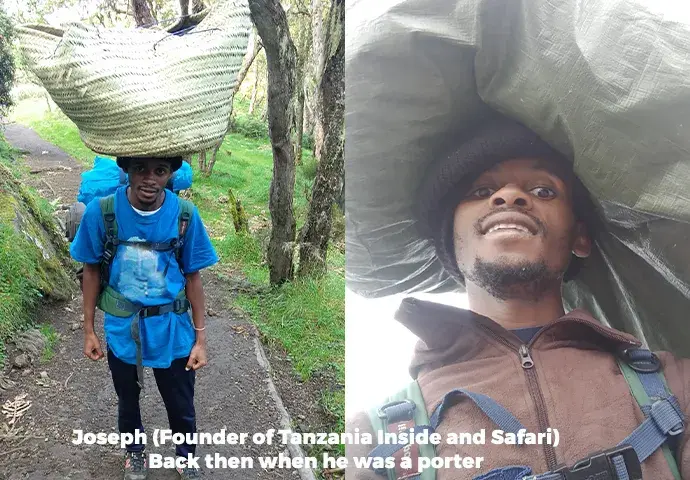
Standard Kilimanjaro routes do not use road access between camps. Almost everything required above the gate must move on foot. This includes:
- Client tents and crew tents
- Sleeping mattresses
- Dining tent, tables and chairs on camping routes
- Food for clients and crew
- Cooking equipment, gas and fuel
- Treated or boiled drinking water containers
- Emergency oxygen and group first-aid equipment
- Portable toilet equipment when booked
- Waste and used supplies being carried down
- Client duffels and selected rental equipment
Porters make it possible for most clients to walk with a manageable daypack containing water, rainwear, warm layers, food and personal essentials. Reducing the client's load helps conserve energy, but it does not remove the demands of altitude. A porter cannot acclimatise on behalf of a climber, and the guide's pace and medical decisions remain essential.
Porters also contribute to the rhythm and morale of camp. Experienced crew members understand the routes, changing weather, campsite routines and the practical signs that someone is struggling. Their observations may help a guide identify a problem early, although medical and safety decisions remain the responsibility of the guiding team.
3. How a Kilimanjaro Mountain Crew Is Organised
The exact crew depends on the number of climbers, route, itinerary length and services included. Titles and responsibilities can overlap, especially in a small private team.
| Crew role | Main responsibilities | Important distinction |
|---|---|---|
| Lead guide | Leads the climb, controls pace, conducts safety checks and makes route, summit and descent decisions | Holds overall operational responsibility on the mountain |
| Assistant guide | Supports the lead guide, monitors climbers and may accompany a client who descends | The required number varies with group size and regulation |
| Cook | Plans and prepares meals, manages the mountain kitchen and food hygiene | May be assisted by kitchen or waiter porters |
| Porter | Carries an allocated load and helps move and establish camp | Work can include tent, water, kitchen or general camp duties |
| Specialty porter | Performs an additional task such as summit support, toilet service, medical support or waiting | Extra responsibility should be recognised in compensation |
A porter is not automatically a guide. Some porters are training and gaining experience toward future roles, but clients should follow instructions from the licensed guiding team.
4. What Happens During a Typical Trekking Day
Before clients wake, some crew members are already preparing hot drinks, breakfast and washing water.
After the climbers leave, the crew normally:
- Clears and cleans the campsite.
- Packs tents, kitchen equipment and shared supplies.
- Organises, weighs or redistributes loads when necessary.
- Walks to the next camp, often at a faster pace than the client group.
- Collects water where required.
- Rebuilds the camp and prepares the kitchen.
- Receives and organises client duffels.
- Prepares drinks, meals and washing water.
- Manages waste and camp hygiene.
On departure day, the process continues until the final equipment reaches the gate and is checked back into the operator's system. The work therefore extends well beyond the hours during which clients see porters on the trail.
5. Understanding the 20-Kilogram Load Standard
The responsible-treatment standard published by the Kilimanjaro Responsible Trekking Organization and Kilimanjaro Porters Assistance Project states that a porter's company load should not exceed 20 kilograms, excluding personal kit.
This distinction matters. A porter needs personal clothing, food, water and sleeping equipment in addition to the assigned company load. A load that weighs 20 kilograms at the gate should not become heavier during the expedition through poor allocation or the addition of unrecorded items.
Park gate weighing is an important control, but responsible management must continue after the group enters the mountain. Food is consumed as the climb progresses, while wet tents can temporarily become heavier. Guides and crew leaders should monitor the distribution of loads and make adjustments when needed.
Why Clients Usually Have a 15-Kilogram Duffel Limit
Tanzania Inside Safari normally limits each client's porter-carried duffel to 15 kilograms, approximately 33 pounds. That allowance leaves room within the wider transport system for shared equipment and helps prevent accidental overloading.
The 15-kilogram allowance does not mean one porter carries only one client's bag. Porter allocation is planned across the expedition according to the total client and company equipment. Climbers carry their own daypacks and should never add unapproved items to a weighed duffel after the gate check.
6. Fair Pay, Written Records and Timely Payment
Mountain-crew pay should meet or exceed the minimum required under current Tanzanian law and applicable Kilimanjaro standards. Because wage orders and stakeholder agreements can change, a responsible article should not rely indefinitely on an old daily figure.
Good practice includes:
- Agreeing the role and rate before the climb
- Recording the crew member's name, role and expedition dates
- Keeping clear payroll records
- Paying the agreed wage promptly after descent
- Avoiding unexplained deductions
- Ensuring a porter does not have to depend entirely on tips
- Explaining any bonus or specialty-duty payment in advance
The KRTO porter-treatment guidance calls for salaries to be paid within two days after descent. Transparent records protect both crew members and responsible operators.
7. Food, Water and Shelter for the Crew
Porters burn substantial energy while carrying loads at altitude. A responsible operator provides three adequate meals per day, sufficient portions and access to safe drinking water. Crew food should be planned as part of the expedition budget rather than being treated as leftovers from client meals.
The crew also needs proper shelter. On camping routes this means tents with adequate sleeping space, sound groundsheets and protection from wind and rain. Sleeping equipment must suit cold high camps. On the Marangu Route, crew accommodation arrangements differ because the route uses huts, but warmth, rest and sufficient sleeping space remain essential.
Poor food and inadequate rest affect more than comfort. They reduce a crew member's ability to carry safely, respond to changing conditions and support the expedition.
8. Clothing and Equipment for Porters
Kilimanjaro passes through environments ranging from humid forest to alpine desert and extreme summit cold. Porters need a functional layering system just as clients do.
Essential equipment includes:
- Supportive footwear with reliable grip
- Moisture-managing base layers
- Warm insulating layers
- Waterproof jacket and trousers
- Warm hat and sun protection
- Liner gloves and insulated outer gloves
- Warm socks
- Suitable sleeping bag and sleeping mat
- Headlamp with working batteries
- A secure personal pack or bag
Equipment should be checked before departure, not after a porter becomes cold or wet. Borrowed gear can be valuable when properly fitted and maintained. KRTO's porter equipment-lending programme makes donated mountain clothing available to crew members free of charge.
9. Health, Altitude and the Right to Descend
Porters are experienced at altitude, but experience does not create immunity to Acute Mountain Sickness, High-Altitude Cerebral Edema, High-Altitude Pulmonary Edema, hypothermia, injury or infection.
A porter who reports symptoms should be assessed seriously. Warning signs such as confusion, loss of coordination, breathlessness at rest, severe weakness or inability to work normally require urgent action. A sick porter should never be pressured to continue carrying or to remain at altitude simply because the group needs the load moved.
Responsible procedures include:
- Removing the load from an ill or injured porter
- Informing the lead guide immediately
- Providing first aid and emergency oxygen when clinically appropriate
- Arranging an accompanied descent when required
- Providing access to medical treatment
- Recording and following up the incident
- Redistributing equipment without overloading another porter
The IMEC Partner for Responsible Travel standards specifically include assistance with descent and medical treatment for an ill porter.
10. Tipping Kilimanjaro Porters Responsibly
Tipping is customary on Kilimanjaro and is an important recognition of the crew's service. It should, however, complement a fair wage rather than compensate for an operator failing to pay one.
There is no single tip amount that fits every expedition. The total depends on:
- Number of trekking days
- Number of climbers
- Exact crew size
- Roles within the crew
- Private or group departure
- Additional services and specialty duties
- The operator's current tipping guideline
Tanzania Inside Safari gives clients a current recommendation and expected crew structure before the climb. The confirmed crew list may be finalised at the gate because illness, availability and operational requirements can produce legitimate last-minute changes.
A Transparent Tipping Procedure
- Receive the recommended tipping guidance before departure.
- Confirm the number of guides, cooks and porters at the pre-climb briefing or gate.
- Decide the group's total tip together, without pressure from the crew.
- Record the total and the intended allocation by role or individual.
- Announce the distribution openly in English and Swahili.
- Whenever practical, give tips directly or use a procedure visible to the full crew.
- Allow crew members to confirm that the stated distribution was received.
KRTO recommends direct, transparent distribution and warns climbers to know the exact crew because people who did not work on the expedition can sometimes appear at a tipping ceremony. Read the organisation's current tipping and porter-treatment guidance before travelling.
Tips should never be demanded during the trek or linked to summit decisions. A guide must be free to turn a climber around for safety without fearing that the crew's compensation will be reduced.
11. Can You Donate Clothing or Equipment?
Climbers sometimes want to leave boots, jackets, gloves or other gear for the crew. A donation can help, but it should be handled thoughtfully.
- Ask the operator before the climb whether a particular item is useful.
- Donate only clean, functional equipment with meaningful remaining life.
- Do not substitute unwanted or damaged gear for a financial tip.
- Avoid promising an item to one person if doing so may create conflict within the crew.
- Use a transparent distribution process through the operator or a recognised lending programme.
- Check airline and customs rules before carrying equipment specifically for donation.
Money and equipment serve different purposes. A porter should not be expected to accept an unsuitable jacket in place of compensation.
12. Women in Kilimanjaro Mountain Crews
Women work as porters, cooks, assistant guides and lead guides on Kilimanjaro, although they remain underrepresented in some roles. Responsible employment means equal access to work, fair allocation of opportunities, appropriate equipment, safe sleeping arrangements and freedom from harassment.
Clients can support inclusion by treating every crew member according to role and professionalism, using the person's name and avoiding assumptions about physical ability or responsibility based on gender.
13. Environmental Responsibilities of the Crew and Climbers
Porters play a major role in moving waste and maintaining camp systems, but environmental responsibility belongs to the entire expedition.
Climbers should:
- Keep litter and used hygiene products in the correct waste bags
- Never leave wipes, batteries or packaging in park toilets
- Follow the guide's instructions on water sources and washing
- Avoid handing loose rubbish to a porter without confirming the correct system
- Use refillable water bottles rather than disposable plastic bottles
- Keep duffel weight within the stated limit
- Leave natural and cultural objects where they are found
Environmental requirements create extra carrying work. Packing carefully and minimising unnecessary waste protects both the mountain and the people who must transport that waste down.
14. Why Extremely Cheap Climbs Create Welfare Risks
Every legitimate climb has unavoidable costs: park charges and taxes, licensed guides, crew wages, food, transport, tents, safety equipment, maintenance, administration and emergency planning.
When a price is far below comparable offers, ask what has been removed. Common risks include:
- Too few porters for the equipment carried
- Excessive loads
- Inadequate crew meals
- Poor tents or sleeping equipment
- Low or delayed wages
- Dependence on tips to replace wages
- Insufficient guide and safety resources
- Uninsured or informal operations
Price alone does not prove whether an operator is ethical, and a high price is not an automatic guarantee of good treatment. The important question is whether the company can clearly explain its crew practices and demonstrate that porter welfare is built into the operating cost.
15. Questions to Ask Before Booking a Kilimanjaro Climb
| Question | What a responsible answer should explain |
|---|---|
| What is the porter load limit? | How company loads are weighed, monitored and kept at or below 20 kg per porter, excluding personal kit |
| What is my duffel allowance? | The exact client limit and what must remain in the daypack |
| How are wages handled? | Current legal or stakeholder minimums, written records and timely payment |
| What do crew members eat? | Three adequate meals, sufficient portions and safe water |
| Where does the crew sleep? | Suitable shelter, sleeping space and equipment for the conditions |
| What happens if a porter becomes sick? | Assessment, removal of the load, assisted descent and medical care when needed |
| How does tipping work? | Current guidance, crew numbers and transparent distribution |
| Who leads the expedition? | Licensed guides, appropriate guide-to-client coverage and clear responsibility |
| How are complaints reported? | A direct route to the operator without retaliation against the crew member |
16. Warning Signs During a Climb
Speak privately with the lead guide or contact the operator if you observe:
- A porter carrying an obviously excessive or unstable load
- Crew members without suitable rainwear, footwear or warm clothing
- Inadequate crew tents or overcrowded sleeping arrangements
- Porters missing meals or asking clients for food because none was provided
- An ill porter being told to keep carrying
- Threats, humiliation, discrimination or physical abuse
- Unexplained deductions from wages or tips
- Pressure on clients to tip before the expedition is complete
- Extra people appearing only for the tipping ceremony
Do not create a confrontation that could place a crew member at greater risk. Record specific facts where appropriate and raise the issue through the lead guide, company management or an independent porter-welfare organisation.
17. How Climbers Can Treat the Crew with Respect
Small actions matter:
- Learn and use crew members' names.
- Greet people and communicate directly rather than only through the lead guide.
- Keep your duffel within the agreed weight.
- Pack wet or dirty items so they do not soak the porter load.
- Do not ask a porter to carry an unapproved personal item.
- Keep essential medicine, water and rainwear in your own daypack.
- Be ready to leave camp at the agreed time.
- Ask permission before taking close portraits or posting an individual's story online.
- Thank the entire team, not only the summit guide.
- Raise welfare concerns calmly and specifically.
Porters are skilled workers and expedition colleagues, not scenery, servants or anonymous labour.
18. Our Kilimanjaro Porter-Welfare Approach
Rooted in Moshi, Tanzania Inside Safari believes that world-class expeditions go hand-in-hand with ethical operations. We are dedicated to total transparency in how we run our company, staying fully compliant with Tanzanian laws, and ensuring our porters and crew receive the fair wages, safe working conditions, and respect they deserve.
Our operating approach includes:
- Licensed local mountain guides and properly organised crews
- A 15-kilogram limit for each client's porter duffel
- Porter allocation designed around the 20-kilogram company-load standard
- Pre-departure equipment and load checks
- Agreed wages recorded and paid through company procedures
- Three crew meals per day and safe drinking water
- Suitable crew shelter and required mountain equipment
- Health monitoring and assistance for sick or injured crew members
- No expectation that tips replace wages
- Tipping guidance and a transparent distribution process
- Respectful conduct and a route for crew concerns
- Responsible waste management on the mountain
Crew numbers vary because different routes and services require different equipment. A longer camping itinerary normally needs more food and fuel than a short hut-based route. A private toilet, specialist medical support or other added service may require additional porters. We explain the likely structure before departure and confirm the working crew at the climb briefing or gate.
19. A More Accurate Way to Talk About Porters
It is important to discuss exploitation and poor practice, but responsible communication should not portray every porter as helpless or every operator as abusive. Kilimanjaro porters are people with different experience, ambitions and circumstances. Many are highly skilled mountain workers; some are progressing toward cook, assistant-guide or lead-guide roles; others use seasonal mountain work alongside farming, trade, education or other employment.
The most useful message is specific: fair wages, safe loads, proper meals, suitable equipment, medical care and transparent tips can be checked and improved. Climbers should choose operators that can explain these systems clearly.
20. Plan a Responsible Kilimanjaro Climb
Your climbing company affects not only your safety and comfort, but also the working conditions of the people supporting your expedition. Compare routes and prices, but also ask how the crew is equipped, paid, fed, housed and protected.
Tanzania Inside Safari will explain your route, expected crew structure, luggage limit, included services and tipping procedure before you climb. Our goal is a well-organised expedition in which clients and crew are treated with dignity and every decision respects the mountain.